
What 19 years in Nigerian solar teach about starting and staying in business
Dr Damilola Asaleye co-founded a solar company with no money of her own and one referred job. Here is how she says to choose a value chain, raise funds and hold quality.
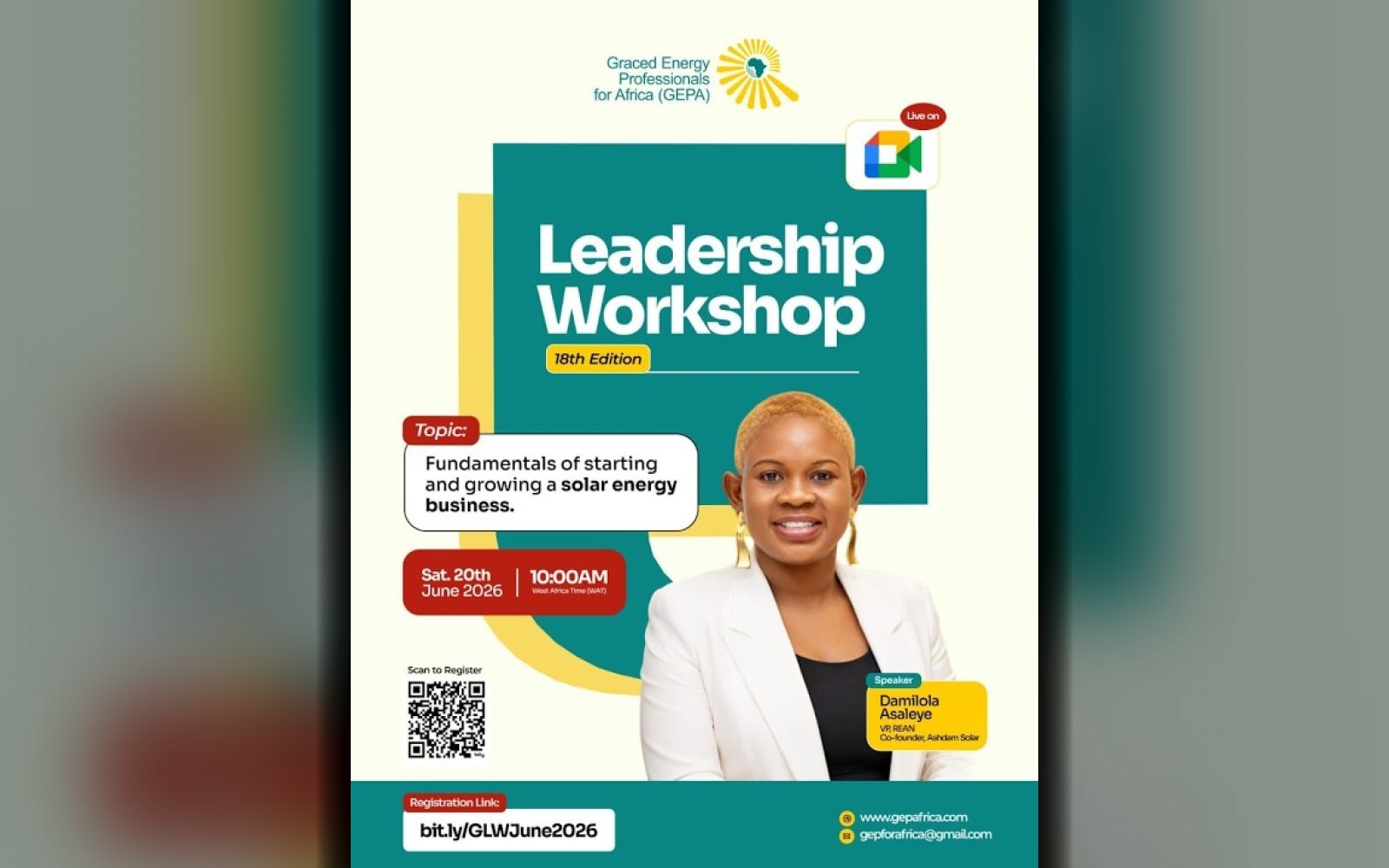
Many people think starting a business in Nigeria, especially a technical one, is very difficult. Dr Damilola Asaleye, co-founder and chief operating officer of Ashdam Solar Company Limited and vice president of the Renewable Energy Association of Nigeria, started without money of her own. Neither she nor her business partner had financial resources. They had family support, determination and visible capacity.
As an undergraduate, Asaleye solved solar problems for anyone who asked, lecturers included. A visiting Fulbright scholar took her on as a research assistant, and after she graduated he referred her and her partner their first job. In a GEPA leadership workshop, she used that business, now 19 years in the market, as her worked example.
Choose where you will play
Solar is not one business. Asaleye names a dozen value chains, from product sales, installation, operations and maintenance to mini-grids, energy as a service, financing, training, manufacturing and energy law. A new company has to choose one, or a combination it can run, rather than claim them all.
Before choosing, she says, settle six questions:
- What problem are you solving?
- Who is your target market?
- What will set you apart when so many others already sell solar?
- What technical expertise do you hold, and what does the value chain require?
- What capital do you need, and can you raise it?
- What skills do you and the people around you have that you can draw on?
Set up as if you mean to grow
That first job paid 700,000 naira in 2007. The founders imported the panels, bought batteries and an inverter locally, and used what remained to register the company and build a website. Asaleye treats the business plan as a working document; her team still returns to it for every application and investor submission.
Keep books from the start. Hers began as handwritten ledgers, moved to spreadsheets and then to software. An investor will ask for revenue, gross profit, net profit and operating expenses, and you should be able to produce them quickly. Written procedures matter too, because people leave and the next person needs to know what to do.
Compliance is not optional if you intend to grow. Her company filed for tax clearance in its first two years, let it lapse, and paid heavy penalties to get back on track. Pension, NSITF and ITF certificates also have to be renewed every year.
Money follows evidence
Personal savings are the strongest start if you have them. If not, Asaleye argues, the realistic first source is family, friends and anyone who has seen your capacity and will take a risk on you.
Beyond that, angel investors, commercial banks, development finance institutions, grant makers and impact investors all ask for the same thing: traction. Investors fund businesses rather than ideas, so a pilot or a record of work already done is what they need to see. Social media has made showing your work far easier than it was 19 years ago, and doing it consistently is part of how you get funded.
Trust and quality keep you in the industry
Asaleye's rule is that people buy trust before they buy solar. Referrals remain her strongest source of work, but they only come if you are visible enough to be talked about. A business approached cold, she has found, will usually give the job to someone it already knows.
Quality is what keeps a company in the market. She will not install a tier two or three product to meet a budget; her company once tried cheaper inverters and had to replace them. Customers who left for a cheaper quote have come back and paid more.
For a brand new to Nigeria, price proves nothing. Ask for its certifications and test a sample, sometimes for months, because the customer comes back to the installer, not the manufacturer.
The full course, taught from the workshop recording, is in the catalogue. It also covers business models, building a first team, and questions from the room on currency risk, starting part-time and following up prospects.


